


If your mechanical watch has suddenly started gaining a lot of time, tens of seconds a day or more, it is probably magnetized. You can check in a minute: bring the watch near a compass and see whether the needle moves, or hold it over your iPhone and read the magnetic field it gives off in microtesla. A magnetized watch is usually a quick, inexpensive fix with a demagnetizer, and it does no lasting damage.
This guide covers how to recognize the symptoms, the two tests and their limits, how to read an iPhone magnetometer result, how demagnetizing works, what an “anti-magnetic” rating really promises, and when the answer is a watchmaker. We build Zen Horology, a watch collection app with a magnetism test, so the screenshots below are from a real iPhone with a real magnetized watch on it.
The signs your watch is magnetized
The classic sign is a sudden change. A watch that has kept the same rate for months starts running well fast overnight, with no knock or drop to explain it. Mechanical wear does not happen overnight. Magnetism does.
The cause is the hairspring, the fine coiled spring that sets the pace of the balance. Omega explains that magnetized parts attract each other, so the hairspring’s coils cannot fully uncoil. Coils that cling together act like a shorter spring, and a shorter spring makes the balance swing faster. Watchmaker writing in Quill & Pad adds that if the coils stick badly enough the watch can stop altogether.
Scroll sideways to compare every column.
What each symptom most often points to
| What you notice | Likely cause | First step |
|---|---|---|
| Suddenly fast by tens of seconds a day or more | Magnetism | Compass or iPhone test |
| Rate jumps around from day to day | Magnetism, or a movement that needs service | Test for magnetism, then time it |
| Stops before the power reserve should run out | Severe magnetism, or low amplitude | Test, then see a watchmaker if clear |
| Slowly drifting slower over months | Tired oils, service due | Track accuracy, plan a service |
| Fast or slow only in some positions | Positional variance | Time it in four positions |
A slow watch is rarely a magnetism problem, so if yours is losing time, start with how accurate an automatic watch should be instead.
What magnetizes a watch
Ordinary things around a desk or a bag. Apple notes that “most consumer electronic devices, including laptops, tablets, smartphones, wearables, and audio devices, contain magnets.” Speakers, laptop lids, magnetic tablet covers, magnetic phone mounts and handbag clasps are the usual suspects, and Omega adds the magnets that hold family photos to the fridge.
Brief contact is usually fine. The common story is a watch left overnight on a speaker or a laptop, or carried for a day next to a magnetic clasp. If you can remember what changed the day the rate jumped, that is often the answer.
The compass test
A compass needle is a small magnet, so a magnetized watch will pull it. This is the test most brand help pages give, Hilts’ help center among them.
- Put a compass on a wooden or plastic table, away from phones, laptops and anything steel. Let the needle settle on north.
- Take the watch off. Slowly bring the case toward the compass from the side, a centimeter or two at a time.
- Move it around the compass, over each side of the case and the crown. A magnetized watch makes the needle swing or follow it.
- Repeat with a watch you know is fine, ideally one with a similar case and bracelet, so you can tell a real pull from the steel of the case itself.
The compass test is cheap and good at catching a strongly magnetized watch. It tells you nothing about how strong the field is, and a mild case may only twitch the needle. That is where a magnetometer helps.
The iPhone magnetometer test
Every current iPhone has a magnetometer, the sensor behind the Compass app. Apple’s Core Motion framework reports it as a magnetic field in microteslas (µT) along three axes. Hold a magnetized watch close to that sensor and the reading jumps, which turns the compass test into a number you can compare and record.
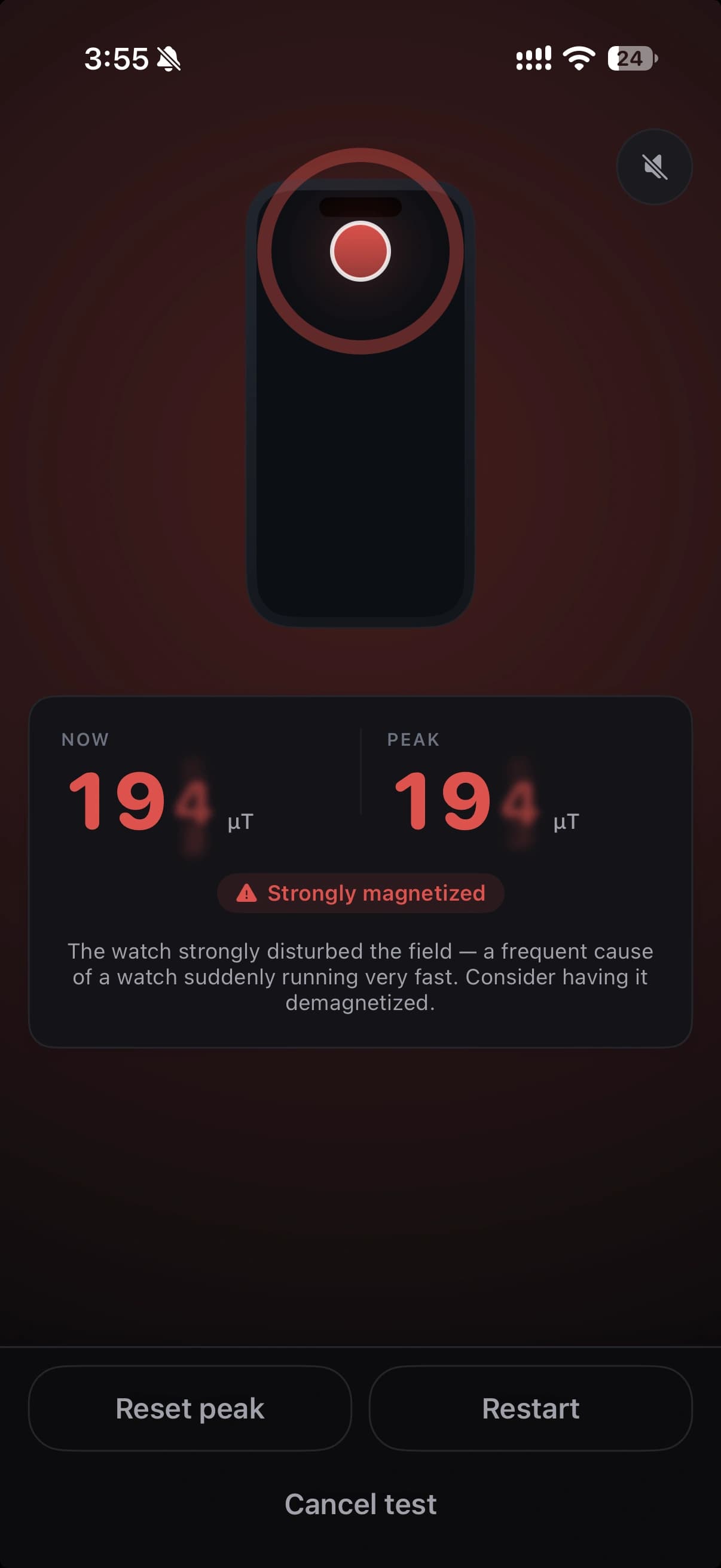
How to run it in Zen Horology:
- Take the iPhone out of any magnetic case or wallet and put it flat on a non-metal table, away from laptops, speakers and chargers.
- Open the Magnetism tab and start the test.
- Hold the watch over the target the app draws on the phone outline, then move it slowly around that spot, case back and crown included.
- Read the two numbers. Now is the live field. Peak holds the highest value seen, so a brief pass over the sensor still counts.
- Tap Reset peak or Restart and repeat once or twice. A reading that comes back the same each time is one you can trust more.
The app turns the number into a plain verdict with a sentence on what it means, as in the screenshot. Magnetism screening is included on the free plan. It needs iOS 17 or later.
What the microtesla number means, and what it does not
Start with the background. NOAA puts Earth’s magnetic field at roughly 25 to 65 µT at the surface (0.25 to 0.65 gauss), depending on where you are. Your phone sees that all the time. A watch that pushes the reading well above it, like the 194 µT above, is carrying a magnetic field of its own.
Readings depend on distance to the sensor, the phone, and what is nearby. Compare readings taken the same way.
Two caveats keep this honest. First, Apple documents that the raw magnetometer value is Earth’s field plus bias from the device itself and its surroundings, so a steel table, a magnetic case or the phone’s own parts all move the number. Second, the reading depends heavily on distance: a centimeter closer can change it a lot. That is why the App Store listing calls the check a screening tool. It tells you whether a watch is worth demagnetizing. It cannot diagnose the movement, and it does not demagnetize anything.
What “anti-magnetic” means: ISO 764 and beyond
The baseline is ISO 764, Horology: Magnetic resistant watches. The current edition is ISO 764:2020, reviewed and confirmed in 2025, and it covers “magnetic resistant watches designed to withstand daily magnetic fields.” The detailed test numbers below come from the previous 2002 edition’s public text, which the 2020 edition replaced.
- A watch marked magnetic resistant must withstand a direct current field of 4,800 A/m, which works out to about 60 gauss (6 mT) in air.
- It must not stop while it is in the field.
- Afterward, its rate may shift by no more than 30 seconds a day, or 45 seconds a day for small movements (20 mm across or less).
- Watches that resist more can carry an extra marking, chosen at 16,000 A/m (about 200 gauss), 40,000 A/m (about 500 gauss) and above.
Scroll sideways to compare every column.
Common magnetic resistance levels, converted to the same units
| Level | Field | In gauss | Source |
|---|---|---|---|
| ISO 764 magnetic resistant | 4,800 A/m | about 60 G | ISO 764:2002, clause 4 |
| ISO 764 extra marking | 16,000 A/m | about 200 G | ISO 764:2002, Annex A |
| Omega Railmaster (historic) | about 80,000 A/m | about 1,000 G | Omega |
| METAS Master Chronometer | 1.5 T | 15,000 G | Omega, METAS tests |
Note how loose the ISO allowance is: 30 seconds a day of residual change still passes. A plain magnetic resistant watch can be magnetized enough to annoy you and still meet the standard. Movements built for METAS Master Chronometer certification are tested in a 15,000 gauss field, which covers far more than daily life throws at them.
How to demagnetize a watch
A demagnetizer makes an alternating magnetic field. Pull the watch slowly out of it and the field it sees keeps flipping while it fades, which scrambles the alignment in the hairspring back to neutral. The HOZAN HC-31 manual describes exactly this: it works “by moving the alternating field away”, with the switch held while you pull back about 30 cm.
With a home demagnetizer
- Stop the watch if you can by pulling the crown to the time-setting position.
- Take off anything else magnetic: other watches, bank cards, phone.
- Hold the watch just above the demagnetizer’s surface.
- Press and hold the button, then slowly lift the watch straight up and away to about 30 cm (a foot).
- Release the button only once the watch is well away. Releasing it next to the device can leave the watch magnetized again.
- Test again with the compass or your iPhone. Repeat the pass if it still reads high.
Home demagnetizers are inexpensive and take seconds. Follow your unit’s limits: many are rated for short bursts only and get hot. The HOZAN manual also warns that the field can affect pacemakers, so anyone with an implanted device should leave this to a watchmaker.
What does not work
- A phone or an app. An iPhone can measure a field but cannot produce the fading alternating field a demagnetizer uses, so no app can demagnetize a watch.
- A permanent magnet waved around the case. It is more likely to make things worse.
- Opening the case to get at the movement. A demagnetizer works through the case.
At a watchmaker
Any watchmaker can demagnetize a watch in a couple of minutes, often while you wait, and one pass is usually enough. If the watch is still under warranty, the brand’s service center is the obvious place, and it can check the rate on a proper timegrapher at the same time.
Confirm the fix: time it again
The magnetism test tells you the field is gone. Only timing tells you the watch is back to its old rate. Do two things after demagnetizing.
- Take a quick timegrapher reading in the same position you used before. A rate that drops back near its usual number confirms magnetism was the cause.
- Log checkpoints against a reference clock for a few days. One reading is a snapshot; several days show the real daily rate.
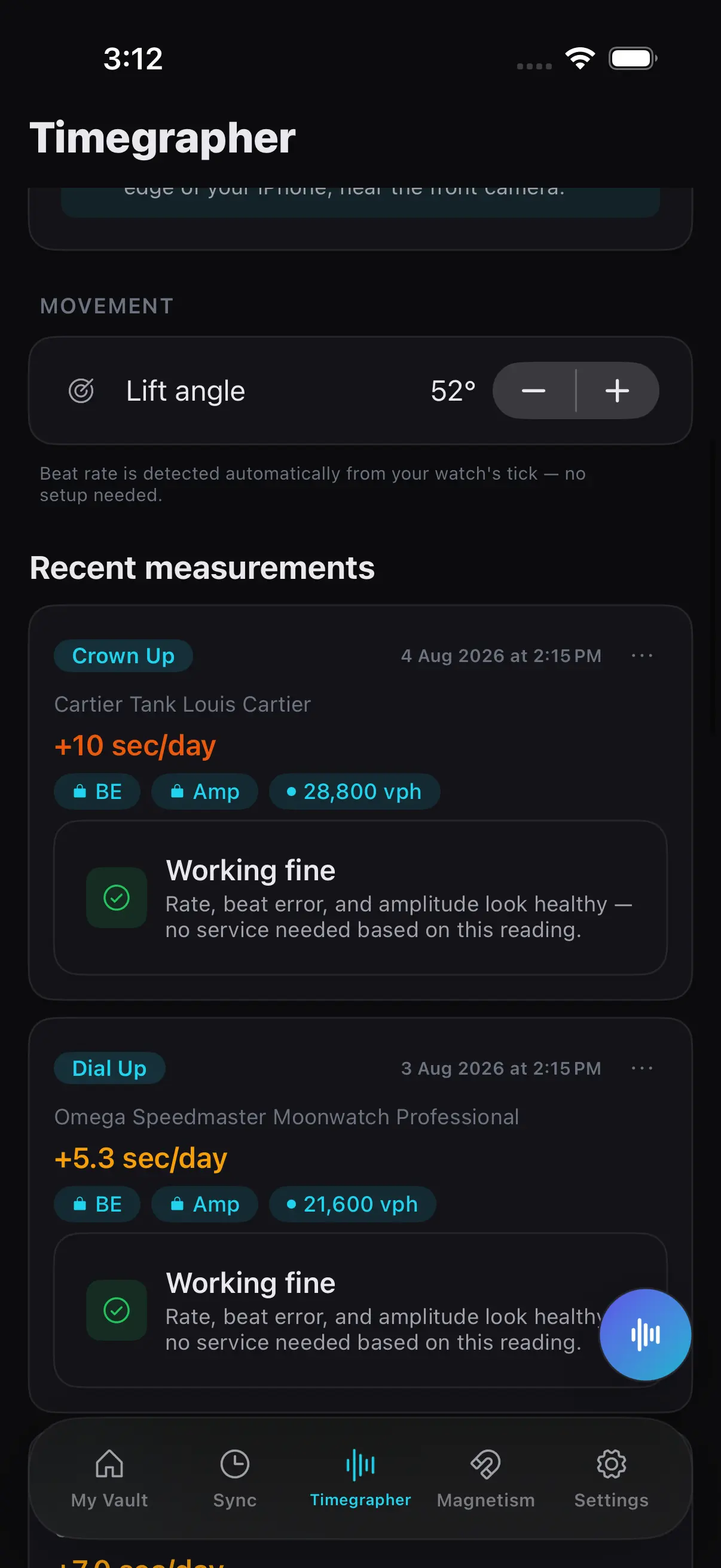
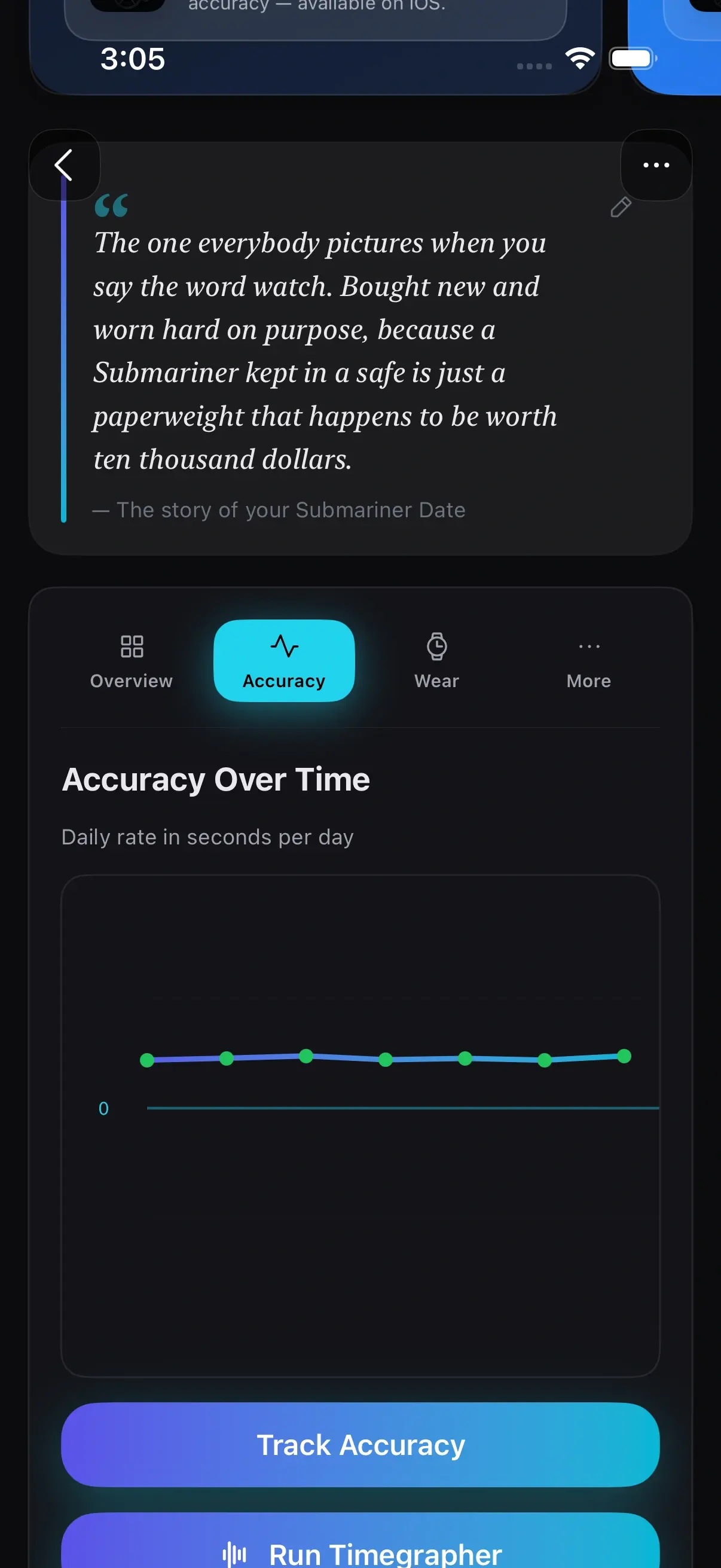
For what the numbers mean, see how to read timegrapher results, and for the checkpoint method, how to track mechanical watch accuracy with an iPhone.
When to see a watchmaker instead
Demagnetizing fixes magnetism and nothing else. Book a watchmaker if any of these apply:
- The watch still runs well fast after a demagnetizing pass and a clean magnetism reading.
- It is losing time, stopping, or its power reserve has shortened. Those point to low amplitude or tired oils.
- The change followed a knock or a drop.
- The rate is erratic from one day to the next even with no field detected.
- It is under warranty, vintage, or valuable enough that you would rather not experiment.
Bring your numbers. A dated log of rate before and after, plus the magnetism reading, tells a watchmaker more than “it seems fast”. If you keep service records alongside each watch, our guide to cataloging a watch collection on iPhone covers how to keep them together.