


How accurate should an automatic watch be? As accurate as its maker rates it, and that ranges from about ±2 seconds a day for a Rolex to -35/+45 seconds a day for an entry-level Seiko. A certified chronometer must average between -4 and +6 seconds a day under COSC’s test, so anything inside that band is excellent for a mechanical watch. Judge your watch against its own specification, measured over a week of normal wear, never against a single reading.
Seconds per day. Sources: COSC, Omega and Rolex, linked in the tables below.
Below are two tables: the certification standards, and the factory tolerances for the calibres inside most affordable automatics. Every figure links to the maker’s or the certifier’s own document. Where we could not find a primary source, the number is left out and we say so. We build Zen Horology, an iPhone app for logging a watch’s rate, so the last section shows how to check yours against these numbers.
Chronometer standards compared: COSC, METAS, Rolex, Grand Seiko
The word “chronometer” on a dial means a third party or the brand tested the movement against a written standard. The standards differ in two ways that matter more than the headline number: whether the test is on the bare movement or the finished watch, and how many positions and temperatures it covers.
Scroll sideways to compare every column.
Chronometer standards in seconds per day. Each tolerance links to the certifier or brand.
| Standard | Tolerance (s/day) | What is tested | Conditions |
|---|---|---|---|
| COSC Chronometer (ISO 3159) | -4 to +6 | Uncased movement | 5 positions, 8, 23 and 38 °C, about 15 days |
| COSC Excellence Chronometer | -2 to +4 | Cased watch | Simulated wear in 6 positions over 24 hours |
| METAS Master Chronometer (Omega) | 0 to +5 (up to 0 to +7 by calibre size) | Movement and cased watch | 8 tests, including 15,000 gauss |
| Rolex Superlative Chronometer | -2 to +2 | Cased watch, after COSC | Rolex’s own protocol |
| Grand Seiko Standard | -3 to +5 | Grand Seiko in-house test | 6 positions, 3 temperatures, 17 days |
| Grand Seiko Special Standard | -2 to +4 | Grand Seiko in-house test | 6 positions, 3 temperatures, 17 days |
Sources: COSC Chronometer, COSC Excellence Chronometer, Omega’s Master Chronometer page, Rolex’s Acacias page and the Grand Seiko 9S manual.
Two things are easy to miss. Plain COSC certifies the movement before it goes into the case, so a COSC watch on your wrist has no published cased tolerance unless the brand adds one. Rolex and METAS test the finished watch, which is why their numbers are the ones to hold a cased watch to.
Grand Seiko is the only maker here that also publishes a target for real use. Its manual says a 9S watch on the wrist should run between -1 and +10 seconds a day (-1 to +8 for the 9S85 and 9S86), wider than its bench standard. That gap is honest: a movement tested on a bench at a steady temperature behaves differently on a moving wrist.
Rolex accuracy per day, month and year
Rolex’s Superlative Chronometer tolerance is -2/+2 seconds a day for the cased watch. At the very edge of that band, every day in the same direction, a Rolex could drift a minute a month. In practice the rate moves around inside the band from day to day, so the monthly total is usually smaller. A Submariner, Datejust or GMT-Master II running at +1 to +2 seconds a day is doing exactly what Rolex specifies.
How accurate should an Omega Seamaster be?
Check the dial and the papers. A current Seamaster marked Master Chronometer passed the METAS tests as a finished watch, so it should run between 0 and +5 seconds a day (Omega allows up to 0/+7 for some calibre sizes). An older Seamaster marked only “Chronometer” was certified by COSC, so -4/+6 applies to the movement and Omega publishes no separate cased figure for it.
What common automatic movements are rated for
Many affordable automatics use a calibre bought from a movement maker. Those tolerances are wide because they cover every movement shipped: Sellita, for example, requires 95 percent of a delivered lot to fall inside its limits. An individual movement may run well inside its range, but the rated figure is all you are owed.
Scroll sideways to compare every column.
Manufacturer-rated tolerances, in seconds per day. Each row links to the maker’s own document.
| Calibre | Maker | Rated (s/day) | Test conditions |
|---|---|---|---|
| Seiko 4R35 / 4R36 | Seiko | -35 to +45 | On the wrist, 5 to 35 °C |
| Seiko 6R35 | Seiko | -15 to +25 | On the wrist, 5 to 35 °C |
| Seiko NH35A | Seiko (TMI) | -20 to +40 | Bench, dial up, 9 up, 6 up |
| Miyota 8215 | Miyota (Citizen) | -20 to +40 | Bench |
| Miyota 9015 | Miyota (Citizen) | -10 to +30 | Bench, posture difference under 30 s |
| Sellita SW200-1 Elaboré | Sellita | 0 to +14 (7 ±7) | Bench, 3 positions, full wind |
| Sellita SW200-1 Top | Sellita | 0 to +8 (4 ±4) | Bench, 5 positions, full wind |
| Sellita SW200-1 Chronomètre | Sellita | COSC criteria | As COSC |
Sources: Seiko’s manuals for the 4R35 and 4R36 and the 6R35; the NH3-series technical guide; Miyota’s data sheets for the 8215 and 9015; and Sellita’s SW 200-1 technical documentation (revision 07, September 2024). Your watch’s specification sheet or manual names its calibre.
Note the conditions column. Seiko’s 4R and 6R figures are for the watch worn on the wrist. The NH35A, Miyota and Sellita figures are bench tests on a fully wound movement in set positions, and Sellita says 95 percent of a delivered lot must fall inside them. A rate measured on your wrist over a week is a different test, so give a bench-rated calibre a little latitude.
What this means in practice: a Seiko 5 gaining 20 seconds a day is in spec. So is an NH35 microbrand diver losing 15. A Sellita Top-grade watch losing 5 seconds a day on the wrist is outside its bench tolerance, and worth a closer look.
Why your daily rate moves: position, wind, temperature and wear
A mechanical watch has no single rate. The makers’ own documents put numbers on each cause.
Scroll sideways to compare every column.
What moves the rate, with the size of the effect where a maker publishes it.
| Cause | What happens | Published size of the effect |
|---|---|---|
| Position | Gravity acts on the balance differently dial up, crown down and so on | Up to 20 s/day between positions (Sellita Elaboré), under 30 s (Miyota 9015), under 60 s (NH35A) |
| State of wind | Rate shifts as the mainspring runs down | ±15 s/day from full wind to 24 h (Sellita Elaboré); -20 to +40 s (NH35A) |
| Temperature | Heat tends to make a watch lose, cold to gain | COSC tests at 8, 23 and 38 °C; Seiko’s rating holds only from 5 to 35 °C |
| How you wear it | Hours on the wrist, arm movement and how fully it is wound | Seiko says the actual rate may fall outside the rated range for these reasons |
| Magnetism | Hairspring coils stick together and the watch runs very fast | Sudden gains of many seconds a day; METAS watches are tested at 15,000 gauss |
Sources: the Sellita, Miyota and NH documents above; Longines on temperature and lubricants; and Seiko’s 4R manual on conditions of use.
Position is the one you can use. A watch usually runs at a different rate dial up than crown down, so the way you rest the watch overnight can nudge the next day’s total. A timegrapher run in each position shows you which way yours goes; our guide to reading timegrapher results explains rate, beat error and amplitude, and why one position is never the whole story.
State of wind explains the most common complaint about automatics: a watch that keeps good time on a weekday and drifts on the weekend. A desk job and an hour at the gym wind the rotor very differently, and a watch running on a half-empty mainspring runs at a different rate from a fully wound one.
Do automatic watches get more accurate over time?
No. None of the makers above says a movement improves with age, and the ones that address ageing say the opposite. Grand Seiko’s manual warns that the oil in the movement may deteriorate with use and recommends an overhaul about every three to four years. Longines says the lubricants break down as a watch gets older, which can reduce accuracy, and suggests a service about every five years.
What does change in the first weeks is you. A new watch gets worn more, wound more fully and rested in a consistent way, and the rate you measure shifts with those habits. That can look like a movement settling in. If the rate genuinely improves after you change nothing, enjoy it, but no maker guarantees it, and you should not buy a watch that runs outside its spec in the hope it will drift into it.
When “out of spec” means booking a service
Grand Seiko gives the clearest procedure of any maker: measure the gain or loss over a week to ten days of normal use, and have the watch adjusted if the average falls outside the target. Apply the same logic to any watch, using its own row in the tables above.
- Log the rate over at least a week of normal wear. A single day, or a single timegrapher reading, is not enough to call a watch out of spec.
- Compare the average with the right number: the cased standard if the brand publishes one (Rolex, METAS, Grand Seiko), otherwise the calibre’s rated range.
- If the watch suddenly runs very fast, tens of seconds a day or more, suspect magnetism before anything else. Demagnetising is usually quick and inexpensive.
- If it is steadily outside spec but the amplitude is healthy, it usually needs regulation, which is a small adjustment.
- If the rate is erratic, the amplitude is low, or the power reserve has shortened, the oils are likely tired and the movement needs a full service.
- If the watch is still under warranty and runs outside a published cased standard, take your log to the brand. Dated numbers are far more persuasive than “it feels fast”.
Steps four and five need a timegrapher reading of amplitude; the timegrapher guide has the healthy ranges. A watch inside its rated band is not broken, however fast it feels next to your phone. A Seiko 4R35 at +30 seconds a day is in spec. A Rolex at +5 is not.
Logging your own rate against the standard
The fair test of an automatic is the one Grand Seiko describes: set it against an accurate reference, wear it normally, and note how far it has moved after several days. You can do that with a notebook. An app saves the arithmetic and keeps every checkpoint, so you can see a trend over months instead of one number.
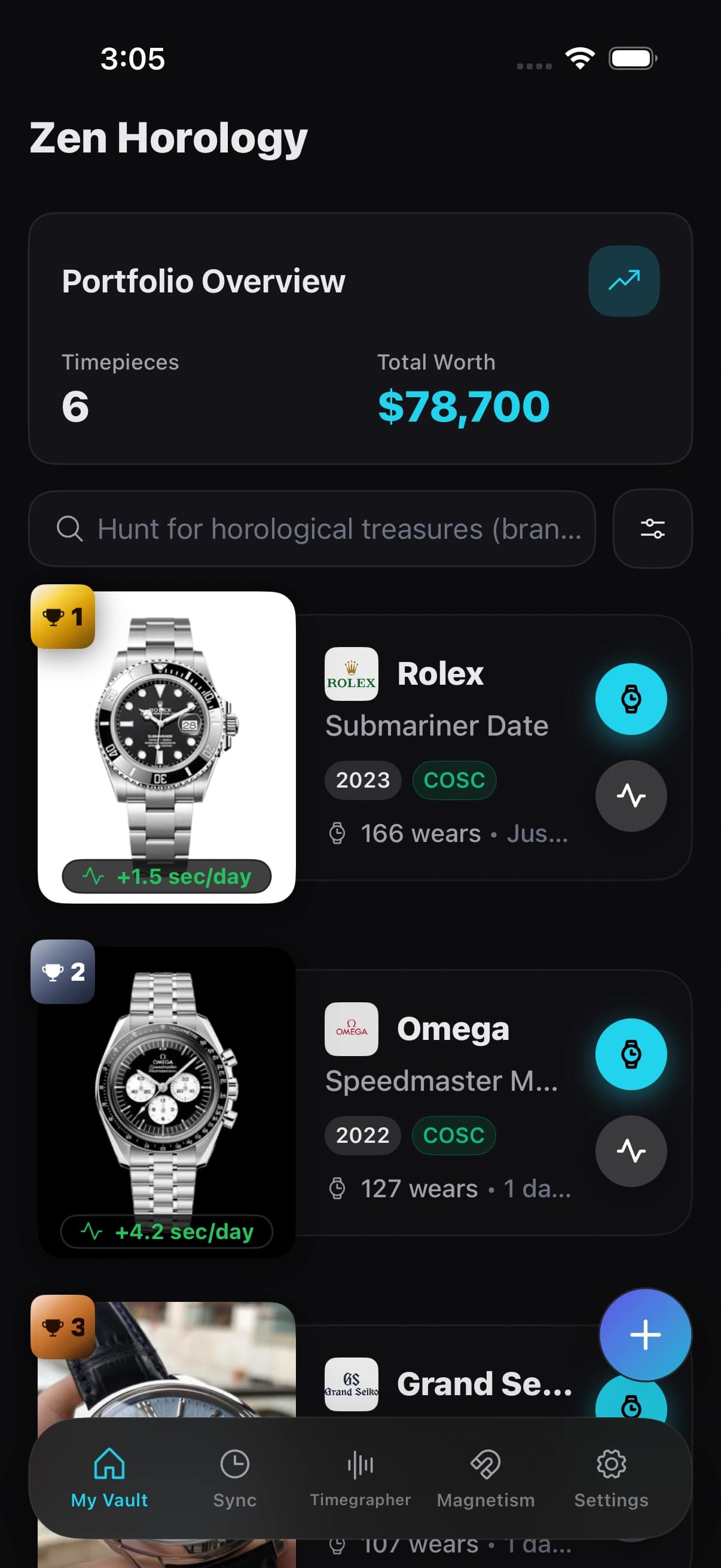
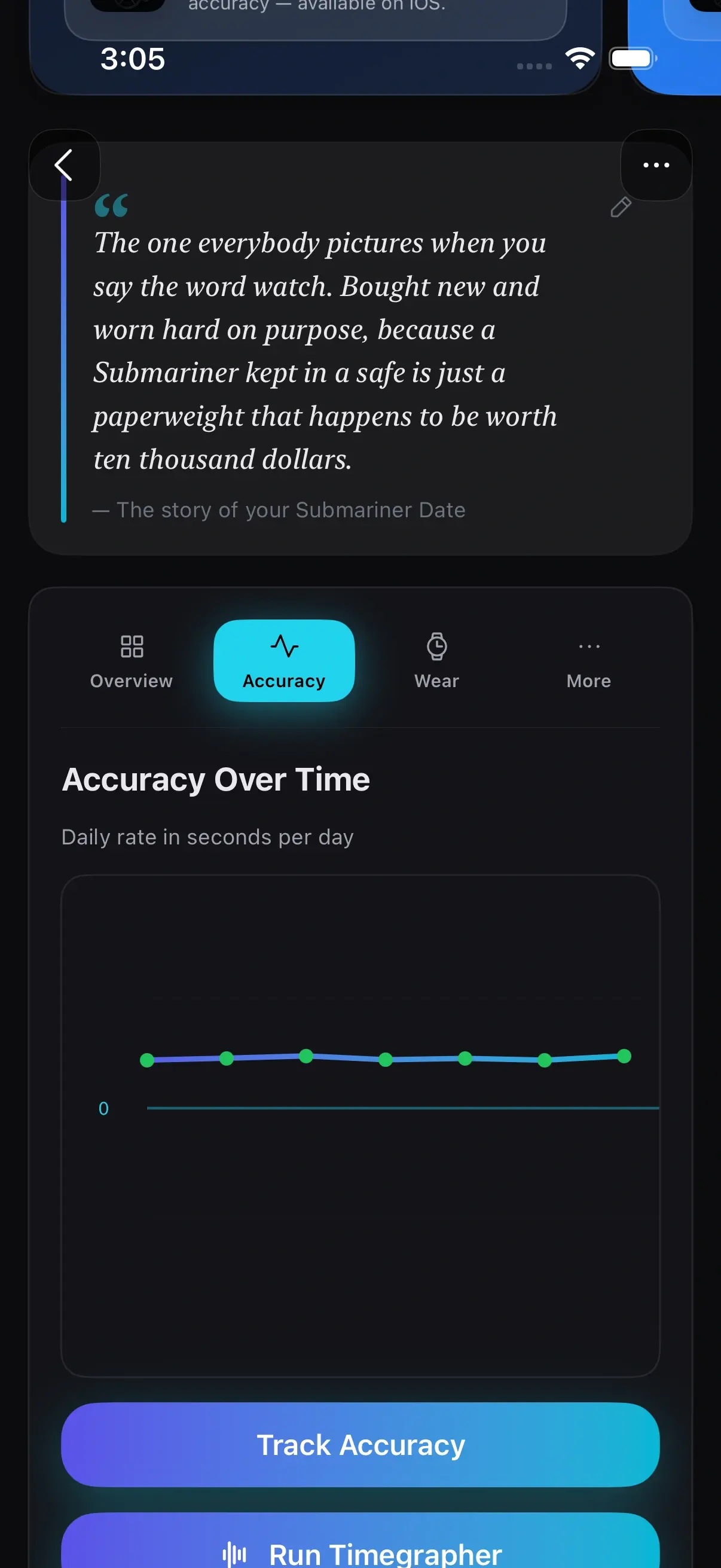
In Zen Horology, the workflow is: open the watch, use the reference clock to set it or note its offset, then log a checkpoint each time you check it. The app works out the daily rate in seconds per day from the gap between checkpoints and plots it on the watch’s Accuracy tab. The step-by-step version, including how to read the dial without parallax, is in how to track mechanical watch accuracy with your iPhone.
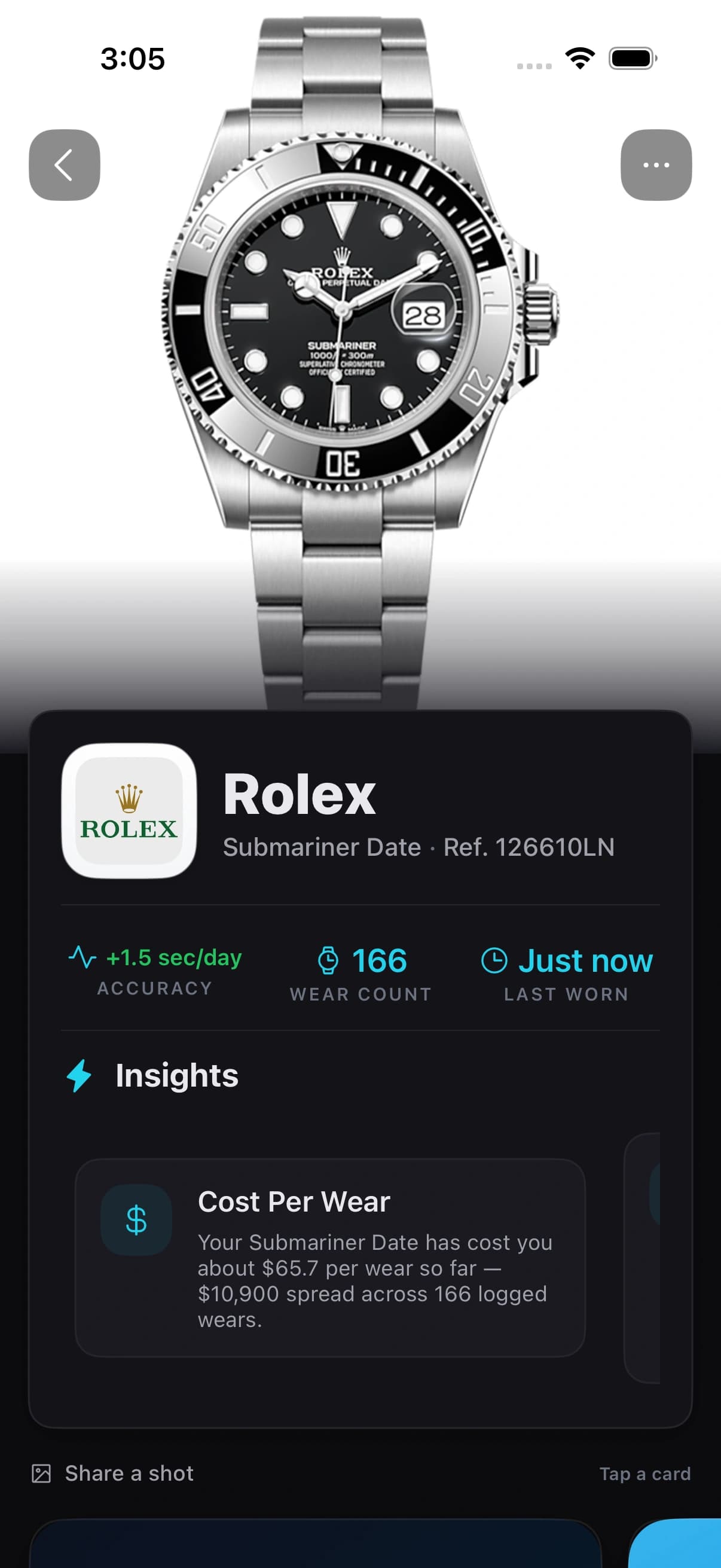
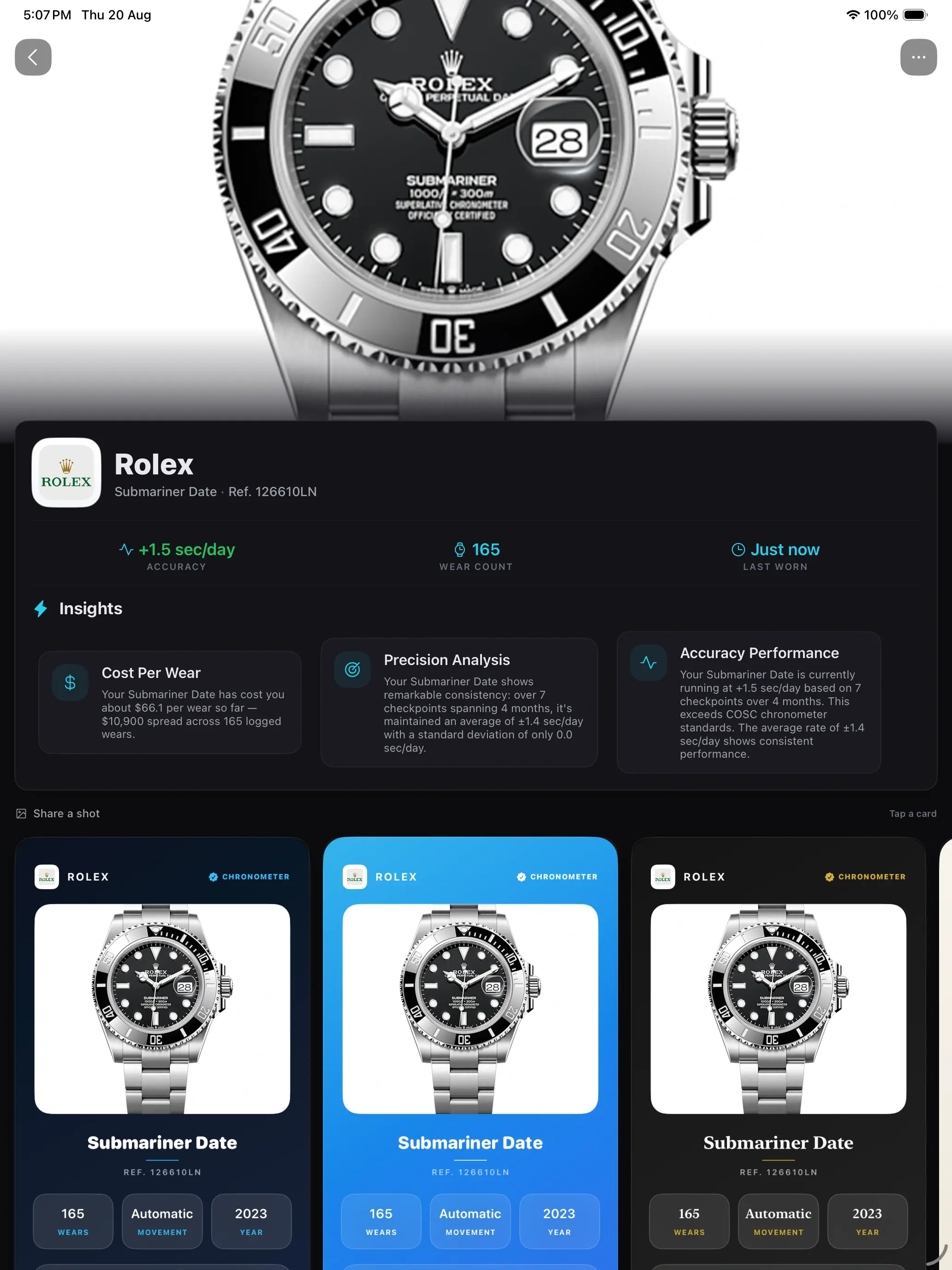
Keep the conditions steady so the numbers mean something: log at about the same time of day, keep the same resting position overnight, and note anything unusual such as a day off the wrist. If you rotate several watches, keep their records and papers together; our guide to cataloguing a watch collection on iPhone covers that side.
What it costs, as of 14 November 2026: the free plan covers two watches with checkpoint accuracy tracking, wear tracking, the reference clock and the timegrapher’s beat rate. Premium is an annual subscription, $19.99 a year on the US App Store, and adds unlimited watches plus beat error and approximate amplitude from the timegrapher. Phone timegrapher readings are estimates for personal tracking and do not replace a watchmaker. Checkpoint logging needs no microphone at all, which is why it is free and why it is the better test of real-world accuracy.