zenproducts  /  head to head  /  reviewed

Zen Passwords vs Bitwarden

Most comparison pages written by a vendor conclude that the vendor wins. This one names what Bitwarden does better first, because you will find it out anyway and because it is the quickest way to know whether to stop reading. What is left after that is a real difference, and it is about what each one does before you change a single setting.

Zen Passwords

3

rounds won

3

draws

Bitwarden

4

rounds won

Our scoring, of our own product against a competitor, so read it with that in mind. Every round below says exactly what it was scored on. Facts about Bitwarden checked against their own published documentation on .

The verdict

Read this part first. If you use Windows, Android or Linux, or you share logins with your family, use Bitwarden. It is free, it is open source, and nothing we have beats free on every device. Still here? Then you are all Apple, and the question narrows to one thing: are you the sort of person who will go into a settings menu and change how your password is turned into a key? Bitwarden still defaults to PBKDF2, with no memory cost at all. Argon2id is there, but you have to switch it on yourself and it is set to 32 MB when you find it. Ours starts at 256 MB and asks you nothing.

The scorecard

All 10 rounds at a glance

Then the same 10 in detail, with what each side actually does and why the round went the way it did.

RoundZen PasswordsBitwardenWinner
1. What one guess costs an attackerArgon2id from the start, up to 256 MB per guessPBKDF2 by default. Argon2id at 32 MB if you switch it onZen Passwords
2. The devices it reachesApple devices onlyApple, Windows, Android, Linux, browsers, webBitwarden
3. Whether there is an account at allNone. You never create oneAn account, or a server you host yourselfZen Passwords
4. Where the vault actually livesYour device, optional private iCloudTheir servers, or your own if you self hostZen Passwords
5. Whether you can read the codeThe crypto is open source. The app is notOpen source, with published auditsBitwarden
6. What you can keep in itSeven item kinds plus passkeys, custom fieldsLogins, cards, identities, notes, passkeysDraw
7. Filling passwords inAutoFill on iPhone, iPad and MacAutoFill plus desktop browser extensionsBitwarden
8. Sharing with other peopleNothingOrganisations, collections, family sharingBitwarden
9. Getting back in when you have forgottenRecovery key or social recovery, never storedNo reset, though an organisation can recover a memberDraw
10. What it costs to startFive active items free, then PremiumA usable free tier, with paid plans aboveDraw
Final3 rounds4 roundsBitwarden

Round 1

What one guess costs an attacker

Zen Passwords

Argon2id from the start, with no menu to find. A new vault works out what your device can afford, starting at 256 MB of memory per guess and stepping down through 128 and 64 only if it cannot unlock in under a second.

Bitwarden

PBKDF2-SHA256 at 600,000 rounds, which is what every account gets unless the person using it goes and changes it. Argon2id is offered, but you have to find it in Settings, Security, Keys, and it is set to 32 MB of memory when you get there.

Winner

Zen Passwords. Judged on what each one does out of the box, which is the only thing that matters at scale. Bitwarden with Argon2id switched on is a good vault. Bitwarden as almost everybody actually runs it has no memory cost at all, and memory is the thing a rack of graphics cards is short of. Eight times their Argon2 setting, without asking you anything. A setting nobody changes is not a feature.

Round 2

The devices it reaches

Zen Passwords

iPhone, iPad and Mac. No Android, no Windows, no browser extension.

Bitwarden

Apple devices, Windows, Android, Linux, every desktop browser, and a web vault you can open from a machine you do not own.

Winner

Bitwarden. Bitwarden is the broadest reach in this category and we are the narrowest. If anything in your week is not an Apple device, this round is the whole decision and the rest is detail.

Round 3

Whether there is an account at all

Zen Passwords

None. You never create one, and there is no vault of yours on a server we run.

Bitwarden

A Bitwarden account, or a server you host yourself if you would rather hold it.

Winner

Zen Passwords. Bitwarden gives you the option to be the host, which is more than most offer and worth saying. But self hosting is a machine you now maintain, and the only setup with no server in it at all is the one where there is no account to sync.

Round 4

Where the vault actually lives

Zen Passwords

On your device. Sync is optional, and when you turn it on it rides your own private iCloud under your Apple ID.

The Sync and backup screen in Zen Passwords, showing encryption before anything leaves the device.
Encrypted here first. iCloud only ever holds ciphertext.

Bitwarden

On Bitwarden servers, encrypted, or on your own if you self host.

Winner

Zen Passwords. Narrowly, and only for the person who wants neither a company nor a server of their own to look after. For everybody else Bitwarden has the better answer here, because their version also works on a Windows laptop.

Round 5

Whether you can read the code

Zen Passwords

The part that turns your master password into your vault key is published at github.com/zenproductsai/zen-vault-core, MIT licensed, with the test vectors that pin it. The rest of the app is not published.

Bitwarden

Open source, with published third party audits.

Winner

Bitwarden. Bitwarden, and we are not going to pretend otherwise. They publish everything and independent auditors have been through it. We publish the piece where a mistake would be unrecoverable, which is a smaller claim, and we have still had no independent audit. Narrower than it was, and still theirs.

Round 6

What you can keep in it

Zen Passwords

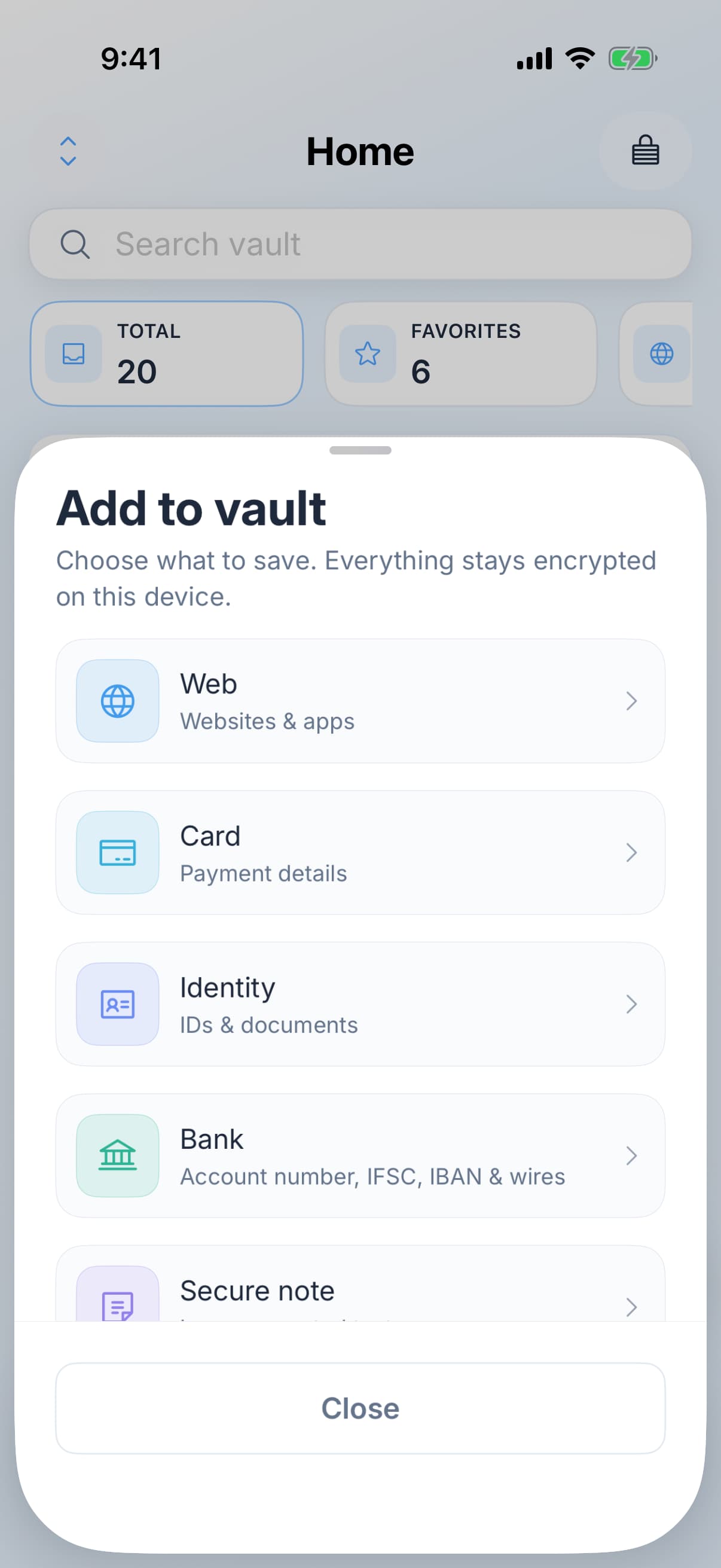
Seven item kinds plus passkeys: logins, cards, bank accounts, identity documents, Wi-Fi, licences and secure notes, each with custom fields.

The Add to vault sheet in Zen Passwords, showing Web, Card, Identity, Bank and other item kinds.
Seven kinds, each with its own fields.

Bitwarden

Logins, cards, identities, secure notes and passkeys.

The Bitwarden vault showing four item types: Login, Card, Identity and Secure note.
Bitwarden’s own screenshot, cropped free of the marketing around it.
Draw

Even. We have a few more named kinds and Bitwarden has custom fields on everything, which gets to the same place. Nobody should choose on this.

Round 7

Filling passwords in

Zen Passwords

AutoFill for logins, one time codes and passkeys in Safari and other apps on iPhone, iPad and Mac.

The AutoFill screen in Zen Passwords, showing AutoFill ready and access granted.
One toggle on day one, then it fills like anything else.

Bitwarden

System AutoFill on Apple devices, plus browser extensions on every desktop browser.

Winner

Bitwarden. Level inside Apple, and outside it we do not appear. If you fill passwords in a browser on a desktop that is not a Mac, only one of these two is in the room.

Round 8

Sharing with other people

Zen Passwords

Nothing. Your vault is yours alone.

Bitwarden

Organisations, collections and family sharing, with per person access.

Winner

Bitwarden. A job we do not do at all. If a login needs to reach somebody other than you, this round has already decided it.

Round 9

Getting back in when you have forgotten

Zen Passwords

A recovery key you keep, or social recovery split across people you trust. Nobody at Zen can let you back in.

The Recovery screen in Zen Passwords, offering a recovery key or splitting it across people you trust.
A key you keep, or trusted people who together can help.

Bitwarden

No reset either, though an organisation can be set up in advance to recover a member account.

Draw

Even. The honest answer is that both of us will tell you no. Bitwarden has organisation recovery if somebody set that up beforehand, and we have social recovery if you set that up beforehand. Two different versions of the same requirement: do the work before you need it.

Round 10

What it costs to start

Zen Passwords

Free for five active items, and you choose which five. Beyond that, Premium.

Bitwarden

A free tier that is genuinely usable, with paid plans above it.

Draw

Even. Bitwarden's free tier is more generous than ours and we are not going to pretend otherwise. Ours is sized to let you use the real app on your own accounts before deciding, not to run your life on. Different intentions, and neither is a trick.

What decides it

Three differences that actually decide it

Both are competent. These are the three where they are genuinely not the same product.

Everywhere, or one place properly

Bitwarden reaches every platform and every browser, which is its central strength. Zen Passwords reaches three Apple platforms and nothing else. Neither approach is wrong, but only one of them fits an estate that includes a Windows laptop.

Open source against a closed app

Bitwarden publishes its source and its audits, so you can check the claim. We do not, so you are trusting it. We would rather write that plainly than bury it, and if it decides the matter for you then Bitwarden is your answer.

An account, a server you run, or neither

Bitwarden gives you a hosted account or the option to host it yourself. Zen Passwords gives you neither, because there is nothing to host: sync, when you enable it, is your own private iCloud under your Apple ID.

So who should choose what

Recommended

Choose Zen Passwords

  • Every device you own runs iOS, iPadOS or macOS, which is who this whole site is built for
  • You want an app that feels built for the platform rather than shared across six of them
  • You want no account and no server anywhere, including one you would have to run yourself
  • You keep cards, bank details, licences and notes alongside logins
  • You would rather have the strongest key derivation by default than the option to configure it

Choose Bitwarden

For the things we do not do

  • You use Windows, Android, Linux or work mostly in a browser
  • Reading the source and the audits is how you decide what to trust
  • You want the option of hosting it yourself
  • You share with a family or an organisation
  • You want a capable password manager for nothing, which Bitwarden genuinely offers

What neither of them fixes

Open source or not, audited or not, these three sit outside what any password manager can do for you.

  • A backup you have never opened. Both products can export your vault, and almost nobody checks that the file they saved actually restores until the day it matters.
  • A single point of failure you chose yourself. One master password, remembered by one person, is the design in both cases, and it fails the same way in both.
  • What happens to the vault after you die or lose capacity. Bitwarden has emergency access for this; Zen Passwords has nothing, and a vault nobody can open is a vault nobody can inherit.

Common questions

Bitwarden is free. Why would I pay for Zen Passwords?

For a lot of people you would not, and Bitwarden is the better answer. The case for paying is that you are on Apple devices only and want a native app holding cards, bank details and notes as well as logins, with no account behind it.

Is Zen Passwords open source?

Partly, and it is worth being exact. The cryptography is: the code that turns your master password into your vault key is published at github.com/zenproductsai/zen-vault-core under an MIT licence, with test vectors produced by the shipping app so you can check it yourself. The app around it is not published, and Bitwarden publishes all of theirs. If reading everything is how you decide, that still points at them.

Can I self-host Zen Passwords like a Bitwarden server?

There is nothing to host. Zen Passwords has no server component at all. Optional sync uses your own private iCloud under your Apple ID, which reaches a similar end by a different route.

I have decided to move across. What is involved?

The export, the import and the parts that need re-checking afterwards are written up separately on our Bitwarden alternative page.

Everything claimed about Zen Passwords here is what the app does today. Everything claimed about Bitwarden is limited to things that have been true of it for years, checked against their own documentation. There are no prices on this page, because a price nobody re-checks goes wrong in public. If something here is out of date, tell us and we will fix it.