zenproducts  /  head to head  /  reviewed

Zen Passwords vs Apple Passwords

Ten rounds, a winner named in every one. The scoring is only worth reading because we lose three of them in public.

Zen Passwords

5

rounds won

2

draws

Apple Passwords

3

rounds won

Our scoring, of our own product against a competitor, so read it with that in mind. Every round below says exactly what it was scored on. Facts about Apple Passwords checked against their own published documentation on .

The verdict

Zen Passwords wins five rounds to three. The three it loses are the three things it genuinely does not do: sharing with your family, reaching a Windows PC, and being free forever with no ceiling.

On everything to do with protecting what is in the vault, Zen Passwords wins: what it takes to open it, what happens if the file is stolen, what you are allowed to keep in it, how you get back in if you forget, and how you get your data out. Those five rounds are the job a password manager exists to do.

Apple Passwords wins three, and they are not close either. It shares with your family, it reaches a Windows PC, and it is free forever with no ceiling. We do none of those three. Not that we do them worse, we do not do them at all. If any one of those is your requirement, Apple wins outright for you and the other seven rounds do not matter.

Two rounds are honest draws, and we would rather mark them that way than claim them. Since version 1.6 we check known leaks as well, and we catch stale passwords that Apple does not, but Apple checks leaks free for everybody while ours sits behind Premium. Honours even.

What we would actually tell a friend

Pick Zen Passwords for anything that would ruin your month: the bank, the email that resets every other account, the cards, the passport. It is the only one of the two where the vault stays shut while your phone is open. Then keep Apple Passwords alongside it for the hundred forgettable logins and for anything you need to share with the family, because that is free and we cannot do it. If you need one app on a Windows work laptop, take Apple and we will not argue.

The scorecard

All 10 rounds at a glance

Then the same 10 in detail, with what each side actually does and why the round went the way it did.

RoundZen PasswordsApple PasswordsWinner
1. What it takes to open the vaultA separate master passwordYour device passcodeZen Passwords
2. If a file gets stolen and attacked offlineArgon2id at 256, 128 or 64 MiB per guessNot something you can see or chooseZen Passwords
3. What you can actually keep in itSeven item kinds plus passkeys, custom fieldsLogins, passkeys, codes, Wi-Fi, Sign in with AppleZen Passwords
4. Filling a password on an ordinary TuesdayFills logins, codes and passkeys on all three devicesBuilt into the OS, nothing to set upDraw
5. Sharing with the people you live withNothingShared Groups, freeApple Passwords
6. The devices it reachesApple devices onlyApple devices plus Windows via iCloud for WindowsApple Passwords
7. What it costsFive active items free, then PremiumFree, unlimited, foreverApple Passwords
8. Telling you a password has gone badReused, weak, old, and a k-anonymous breach check on PremiumReuse and weakness, plus known data leaksDraw
9. Getting back in when you have forgottenPrintable recovery key plus social recoveryPasscode, recovery contact or recovery keyZen Passwords
10. Leaving, if you want toScheduled encrypted backups plus import from five appsExport to file, passkeys app to app in iOS 26Zen Passwords
Final5 rounds3 roundsZen Passwords

Round 1

What it takes to open the vault

Zen Passwords

A master password you choose, which is not your passcode and is never typed to answer a text or pay for coffee. Face ID handles day to day unlocking once you turn it on.

The Zen Passwords home screen, showing saved items and a locked vault button.
The lock is the app's own, not the phone's.

Apple Passwords

Face ID or Touch ID, falling back to your device passcode. The same six digits that unlock the phone. Apple's own recovery documentation lists that passcode as a way back into end to end encrypted iCloud data.

Winner

Zen Passwords. A phone thief who watched you type your passcode has your photos, your messages and your email. With Apple Passwords they also have every account you own. With a separate master password the vault stays shut while the phone is wide open.

Think of it like a house key and a safe

Most people keep valuables in a safe inside the house, not in a drawer, and the safe has its own combination. Not because the front door lock is weak, but because the front door is the lock you open a dozen times a day, in front of neighbours, delivery drivers and anyone walking past. Apple Passwords keeps the valuables behind the front door. We think they belong in the safe.

Round 2

If a file gets stolen and attacked offline

Zen Passwords

Argon2id, a function built to be expensive in memory rather than merely slow. New vaults start at 256 MiB per guess and step down through 128 and 64, keeping the strongest tier that still unlocks in under a second on that device.

Apple Passwords

End to end encrypted by default, with the keys on your trusted devices, under both standard and Advanced Data Protection. Genuinely strong. How the passcode is stretched is not something you can see, choose or tune.

Winner

Zen Passwords. Narrowly, and for one reason: you can see the number. Apple's encryption is excellent and we will not pretend otherwise. But a six digit passcode is a small secret, and we publish exactly how expensive each guess against ours is. Memory cost is what defeats the graphics cards used to guess passwords in bulk.

Round 3

What you can actually keep in it

Zen Passwords

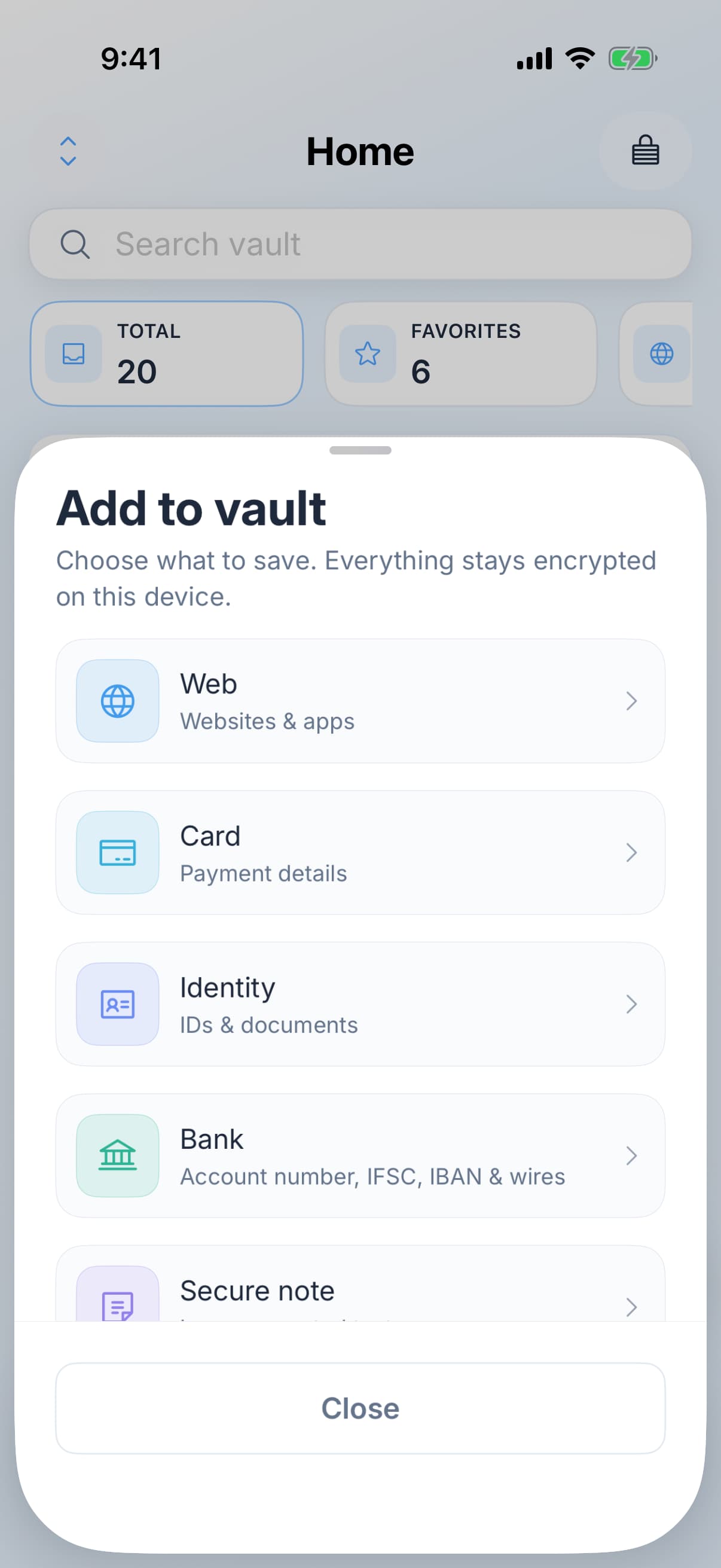
Seven kinds of item plus passkeys: web logins, cards, bank accounts, identity documents, Wi-Fi, software licences and secure notes. Each with its own fields, and custom text, password or number fields on any of them.

The Add to vault sheet in Zen Passwords, showing Web, Card, Identity, Bank and other item kinds.
Everything below Web is something Apple Passwords has nowhere to put.

Apple Passwords

Logins, passkeys, verification codes, Wi-Fi passwords and Sign in with Apple credentials. That is the whole list. No card, no bank account, no passport, no software licence, no standalone secure note.

Apple’s Passwords app showing a list of 153 saved website logins.
Apple’s own screenshot. 153 items, and every one of them a website login.
Winner

Zen Passwords. This one is not close. With Apple Passwords your passport number ends up in Notes and your account details end up in a photo of a letter. Those are the two least protected places on the phone.

Round 4

Filling a password on an ordinary Tuesday

Zen Passwords

Fills logins, one time codes and passkeys across Safari and other apps on iPhone, iPad and Mac, and offers to save new passwords as you go. It asks you to switch it on once, in system settings, on the day you install it.

The Authenticators tab in Zen Passwords, showing live one time codes.
One time codes sit beside the logins they belong to.

Apple Passwords

Built into the operating system. Nothing to enable, nothing to grant, no extension to install. It fills logins, passkeys and verification codes across Safari and apps from the day you get the phone.

Draw

Even. Both fill the same three things, logins, one time codes and passkeys, in the same places on the same devices. Apple starts switched on and we ask for one toggle on day one. That is a difference of about fifteen seconds, once, and we are not going to lose a round over it or pretend it does not exist.

Round 5

Sharing with the people you live with

Zen Passwords

Nothing. Your vault is yours alone. If you need to hand your partner the Netflix login, you will do it the way you always have, by reading it out.

Apple Passwords

Shared Groups. Free. Share passwords, passkeys and Sign in with Apple credentials with family and trusted contacts, and everyone in the group can see and update them.

Winner

Apple Passwords. By default and by a mile. This is the biggest hole in our product and it is on the roadmap, which is not the same as being available to you today. If sharing is why you are reading this, Apple has your answer and we do not.

Round 6

The devices it reaches

Zen Passwords

iPhone, iPad and Mac. No Android, no Windows, no browser extension.

Apple Passwords

iPhone, iPad, Mac and Apple Vision Pro, plus a Windows PC through iCloud for Windows with Chrome or Edge. No native Android app, but iOS 26 can export passkeys to a manager that does run there.

Winner

Apple Passwords. One work laptop running Windows is enough to settle this round, and plenty of people have one.

Round 7

What it costs

Zen Passwords

Free for five active items, and you choose which five stay fully openable. Beyond that, Premium.

Apple Passwords

Free. Unlimited items. No tier, no upsell, no ceiling, forever.

Winner

Apple Passwords. Nobody beats free and unlimited. Five items is enough to try the app properly and not enough to run your life on, which is exactly what it is for.

Round 8

Telling you a password has gone bad

Zen Passwords

An on device scan for reused passwords, weak ones under twelve characters, and old ones you have not changed in a year, plus an opt in check of your saved logins against known data breaches. The breach check uses k-anonymity with padded responses, so no password and no full fingerprint ever leaves the phone. The breach part is a Premium feature.

Apple Passwords

Flags passwords that are easily guessed or reused, and warns you when one appears in a known data leak. The leak check is the part that matters, because it tells you about a breach at someone else's company.

Draw

Even. Even, and closer than it was. Since version 1.6 we check known breaches too, using k-anonymity with padded responses so nothing identifying leaves the phone. We also catch passwords that have sat untouched for a year, which Apple does not. What keeps this a draw rather than a win is price: Apple checks leaks for everybody free, and ours is a Premium feature you opt into.

Round 9

Getting back in when you have forgotten

Zen Passwords

A thirty two character recovery key, printable as a sheet for a drawer, from an alphabet with no zero, capital O, one or capital I so you cannot mistype it. It is never stored anywhere. Or social recovery, which splits that key across people you trust, so a few of them together can help you back in and no single one of them can get in alone.

The Recovery screen in Zen Passwords, offering a recovery key or splitting it across people you trust.
Nobody at Zen can open your vault, which is exactly why this screen has to be good.

Apple Passwords

Your device passcode, a recovery contact, or a recovery key. Well built, and reliant on your Apple account being reachable.

Winner

Zen Passwords. We match Apple's recovery contacts with social recovery, and its recovery key with ours, which is never stored anywhere by anyone. What we do not offer is the third route, your device passcode, and that is deliberate. A recovery path is also an entry path, and the passcode is the one this whole comparison is about.

Round 10

Leaving, if you want to

Zen Passwords

Encrypted backups you can prepare, share, and schedule to run daily, weekly or monthly on their own, plus import from 1Password, Bitwarden, LastPass, Chrome, and plain CSV or JSON.

The Sync and backup screen in Zen Passwords, showing scheduled encrypted backups set to weekly.
The round in one screen: a cadence, not a reminder to do it yourself.

Apple Passwords

Export your data to a file, and in iOS 26 hand passkeys and codes straight to another manager app to app, instead of dumping a plaintext CSV. That is a real improvement and worth saying so.

Winner

Zen Passwords. Apple's app to app passkey handover in iOS 26 is genuinely better than ours for passkeys specifically, and we will say so. But an export you have to remember to run is not a backup. A scheduled encrypted backup that runs weekly without being asked is, and Apple Passwords has no equivalent to it at all.

6 digits

is what separates a stranger from every account you own, if your passwords live behind your passcode.

What decides it

Three differences that actually decide it

Not a feature list. These are the three that change which app you should install.

What counts as an item

Apple Passwords is built around credentials: logins, passkeys, Wi-Fi and verification codes. Zen Passwords treats a payment card, a bank account, a software licence and a secure note as first-class items sitting beside your logins. If your list is only credentials, this difference is worth nothing to you.

Who can get you back in

Apple can, through account recovery. We cannot, because we never receive your master password and hold nothing that would let us. That is a genuine advantage for Apple and a genuine trade you are making, in both directions, and anyone who presents it as purely a win for us is selling you something.

Whether it is one more app

Apple Passwords is already installed and already configured. Zen Passwords is a separate app you open, with a master password you set and remember. That friction is real, and it is only worth accepting if the first difference above applies to you.

So who should choose what

Recommended

Choose Zen Passwords

  • Your card details are currently in a note, and a photo of a document is in your camera roll
  • You want logins, cards, bank details, licences and notes under one lock and one search box
  • You would rather no company at all held a copy of your vault, including Apple
  • You want the vault to stay shut even while the phone is unlocked

Choose Apple Passwords

For the things we do not do

  • You share logins with family, because Shared Groups are free and we have nothing
  • A Windows PC is part of your week
  • You want a vault that is free and unlimited forever
  • You would rather not install or learn another app

What most people should actually do

Run both, split by what you would lose

  • The twenty accounts that would ruin your month go in Zen Passwords: bank, primary email, cards, passport.
  • The hundred forgettable logins stay in Apple Passwords, filling instantly and costing nothing.
  • Neither app stops you, and import handles the move in an afternoon.

What neither of them fixes

These two share a foundation, which means they share the same four blind spots. Neither app can help with any of them.

  • A four digit device passcode. Both of these ultimately sit on top of your phone unlocking, and a passcode somebody can watch you type undoes everything above it.
  • A phone handed over unlocked. At a border, in a repair shop, or to somebody you trusted, whatever is open is open.
  • Somebody talking you into reading out a code. Far more accounts are lost this way than to anything cryptographic.
  • A shop or a bank leaking your card details from their own systems. Nothing stored on your phone has any reach into that.

Common questions

Is Apple Passwords enough on its own?

For website logins, passkeys, Wi-Fi and verification codes, yes, and for a lot of people that is the whole list. Add something else only when you find yourself keeping cards, bank details or documents somewhere they do not belong.

Can I use both at once?

Yes, and plenty of people do. Apple Passwords keeps doing logins in Safari, and Zen Passwords holds the things that have nowhere else to go. There is no conflict between them.

Which is safer?

Both encrypt your data, and the honest answer is that the difference between them is not the encryption. It is who can get back in when something goes wrong. Apple can help you. We cannot, which removes us as a target and removes us as a rescue at the same time.

I have decided to move. What now?

The handover, including what exports cleanly and what you re-enter by hand, is written up separately on our Apple Passwords alternative page.

If your passcode opens your phone in public, it should not also open your bank.

Zen Passwords on the App Store
How every round was scored, and where the facts came from

We would rather show our work than ask you to take a scoreline on faith. Apple's side was read from Apple's own published documentation. Ours was checked against our own source. A round went to whoever a careful buyer would say does the job better today, not whoever has it on a roadmap. Where the two do different halves of the same job, or the gap is a one time setup step, we marked it a draw rather than awarding it to either side.

iCloud data security overview
That Passwords and Keychain is end to end encrypted under both standard and advanced data protection, and that the recovery paths are a device passcode, a recovery contact or a recovery key.
The Passwords app support page
Item types, Shared Groups, security alerts, the platform list, and Windows access through iCloud for Windows with Chrome or Edge.
Six Colors, on the iOS 26 export
The app to app handover of passkeys and codes to another manager, rather than a plaintext file.
Observed, not quoted
One claim in round one is observed behaviour rather than a quoted line: that opening the Passwords app authenticates with Face ID or Touch ID, which falls back to the device passcode. That is how system authentication works on iOS, and it is the single sentence here we cannot point at a document for.
Our own side
Item kinds, the Argon2id tiers and the one second calibration budget, the five item free tier, the recovery key alphabet and length, the health scan thresholds, the scheduled backup cadences, social recovery and the import sources all come from our own source. Vault contents are sealed with AES-GCM and sync as ciphertext through a private database on your own Apple ID.

These are our own readings of our own implementation, current as of this writing, offered in the interest of transparency rather than as a substitute for independent review. Corrections and questions are welcome.

Everything claimed about Zen Passwords here is what the app does today. Everything claimed about Apple Passwords is limited to things that have been true of it for years, checked against their own documentation. There are no prices on this page, because a price nobody re-checks goes wrong in public. If something here is out of date, tell us and we will fix it.