


There is no fixed age to stop tracking baby feeds and diapers. The early log exists to answer one question, whether feeding is going well, and once your pediatrician is happy with your baby’s weight and has stopped asking for counts, you can usually taper to one log or stop. Ask at the next checkup: it is a logistics decision you make together, and you can start again any day a question comes up.
If you are searching when to stop tracking baby feeds and diapers, you may be tired of the app, or worried that you cannot stop. Both are common. One parent on a HelloBee thread called the log a safety net and wrote, “I fear not knowing everything.” The replies ranged from parents who stopped after a few weeks to parents who kept a sleep log for years. None of them were doing it wrong.
This page is about record keeping, with Zen Otto, our one-handed baby log for iPhone, where it helps. It gives no feeding amounts, diaper counts, weight figures or schedules; those come from your pediatrician and the sources linked here.
Why the first weeks get logged
In the first days nobody can see how much milk goes in, especially with breastfeeding. Wet and dirty diapers and weight are the visible clues. The American Academy of Pediatrics explains on HealthyChildren.org how to tell if your baby is getting enough milk, including what diapers look like by age and why the first checkup comes soon after you leave the hospital: the weight check at that visit “will help to know if your baby is getting enough milk.”
The AAP is specific about when a written log earns its place. Its page on warning signs of breastfeeding problems says: “If you or your pediatrician is concerned about your child’s milk intake, you might want to keep a written record of your baby’s wet diapers and bowel movements during the early days.” Read that sentence twice. It is conditional, and it is about the early days. The log is a tool for a question, with a natural end.
The NHS says the same thing from the weighing side: “Your baby will be weighed during their first 2 weeks to make sure they’re regaining their birthweight,” according to its page on baby height and weight. If you are in the UK, the NHS guidance on the first few days of breastfeeding points you to your midwife or health visitor if you think your baby is not getting enough milk.
What your pediatrician may ask for
The AAP publishes checklists of what happens at each visit, and they show what comes up. At the first-week checkup, the doctor will measure and weigh your baby and may ask whether your baby gets breast milk, formula or both. The list also asks you to bring the hospital paperwork with the discharge weight.
At the one-month checkup, the sample questions include “How many wet diapers and stools does your baby have each day?” and “How’s your feeding routine going?” Those are rough-count questions. A day or two of entries lets you answer from the record instead of from a sleep-deprived memory. The same checklist suggests writing your own questions down before the visit.
Add one question to that list: “Do you need me to keep tracking anything until the next visit?” Some pediatricians want feeds and diapers for another week or two. Many will say it is no longer needed. Either answer settles most of this article for your family.
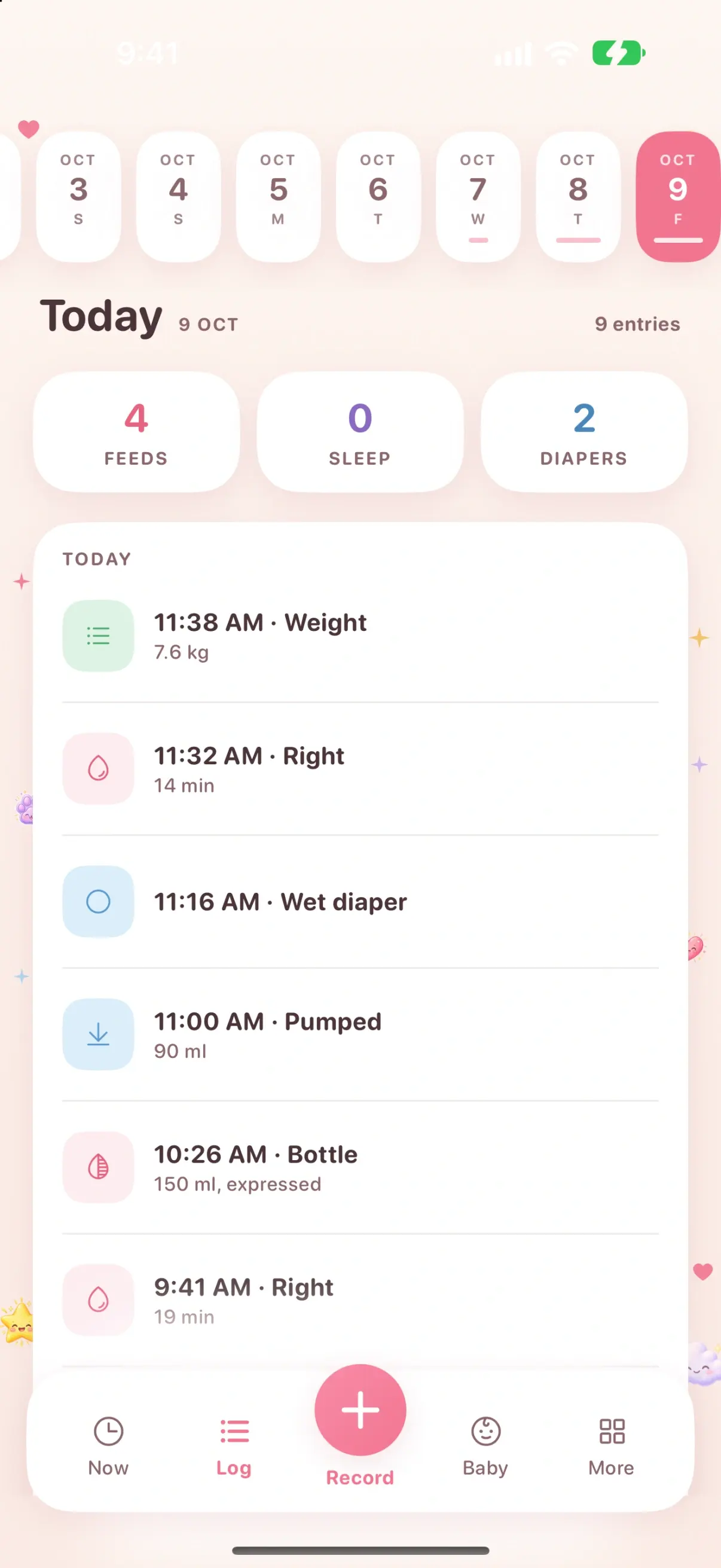
Signs the log has stopped helping
A log is worth keeping while someone uses it to decide something. These are the signs that nobody does anymore:
- Your pediatrician is satisfied with weight gain and has not asked for counts. If you are not sure, ask directly.
- Any specific instruction from a clinician, such as watching intake or weighing between visits, has been lifted.
- Nobody looks back. If yesterday’s entries were never opened, they are not informing a decision.
- Most entries are guesses typed in hours later. A reconstructed log looks precise and is not.
- The log causes more stress than it relieves: you check the numbers before you look at your baby, or caregivers argue over missing entries.
The opposite is also true. Many parents find a log calming long after the newborn weeks, and a feed entry takes seconds. If it helps and costs you little, keeping it is a fine choice. The goal is a log that serves you, whichever way that goes.
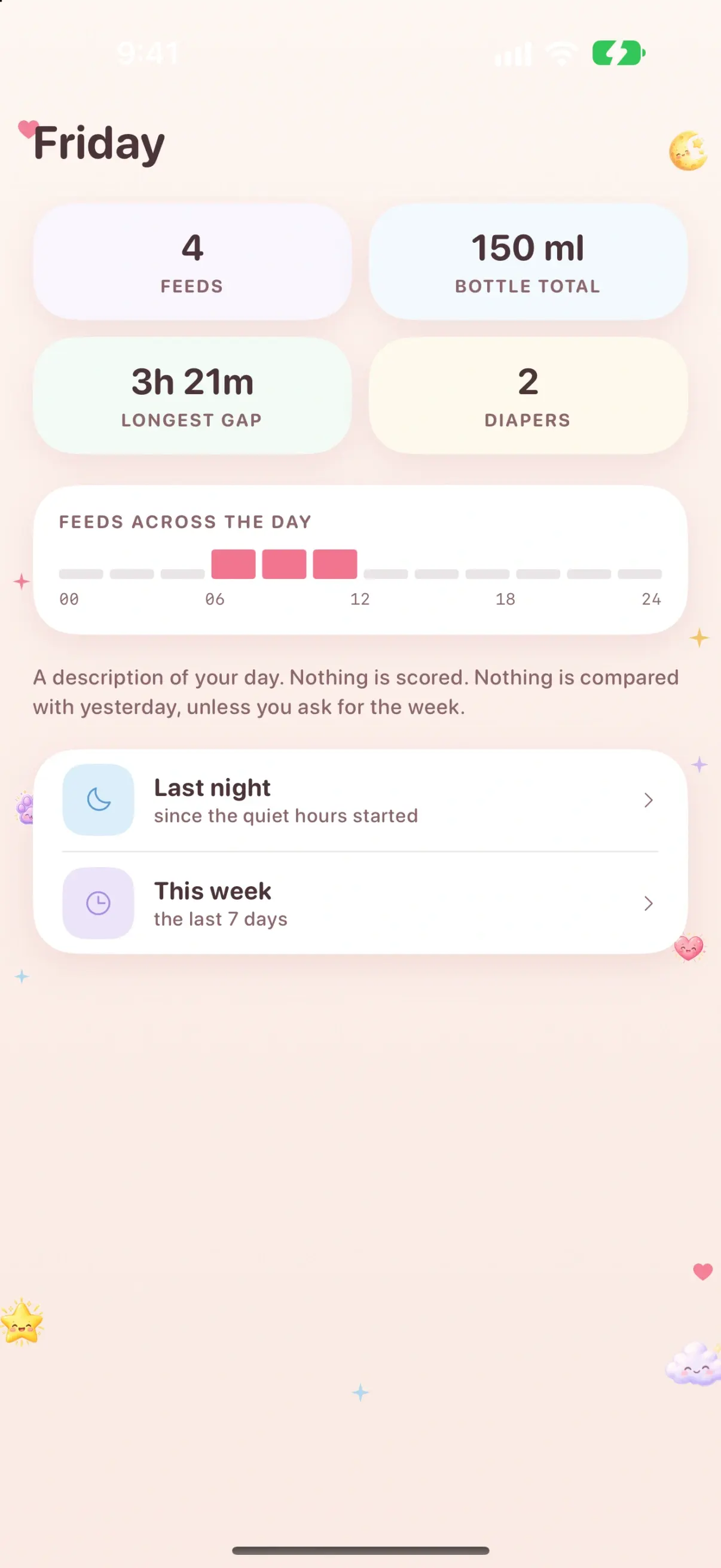
Taper instead of quitting: keep one thing
After weeks of logging every diaper, stopping everything at once can feel like losing sight of your baby. Dropping one category at a time is easier. In forum threads, parents most often describe diapers going first, feeds later, and sleep last. Choose the one log that still answers a question you actually ask.
Scroll sideways to compare every column.
Pick the single log that matches the question you still ask. Everything else can stop.
| Keep only | Useful when | The question it answers |
|---|---|---|
| Feeds | You are breastfeeding or combination feeding | When did the last feed start, and which side? |
| Nights | Two caregivers split the night | What happened while I was asleep? |
| Medicine | Your baby is on any medicine, even briefly | When was the last dose, and who gave it? |
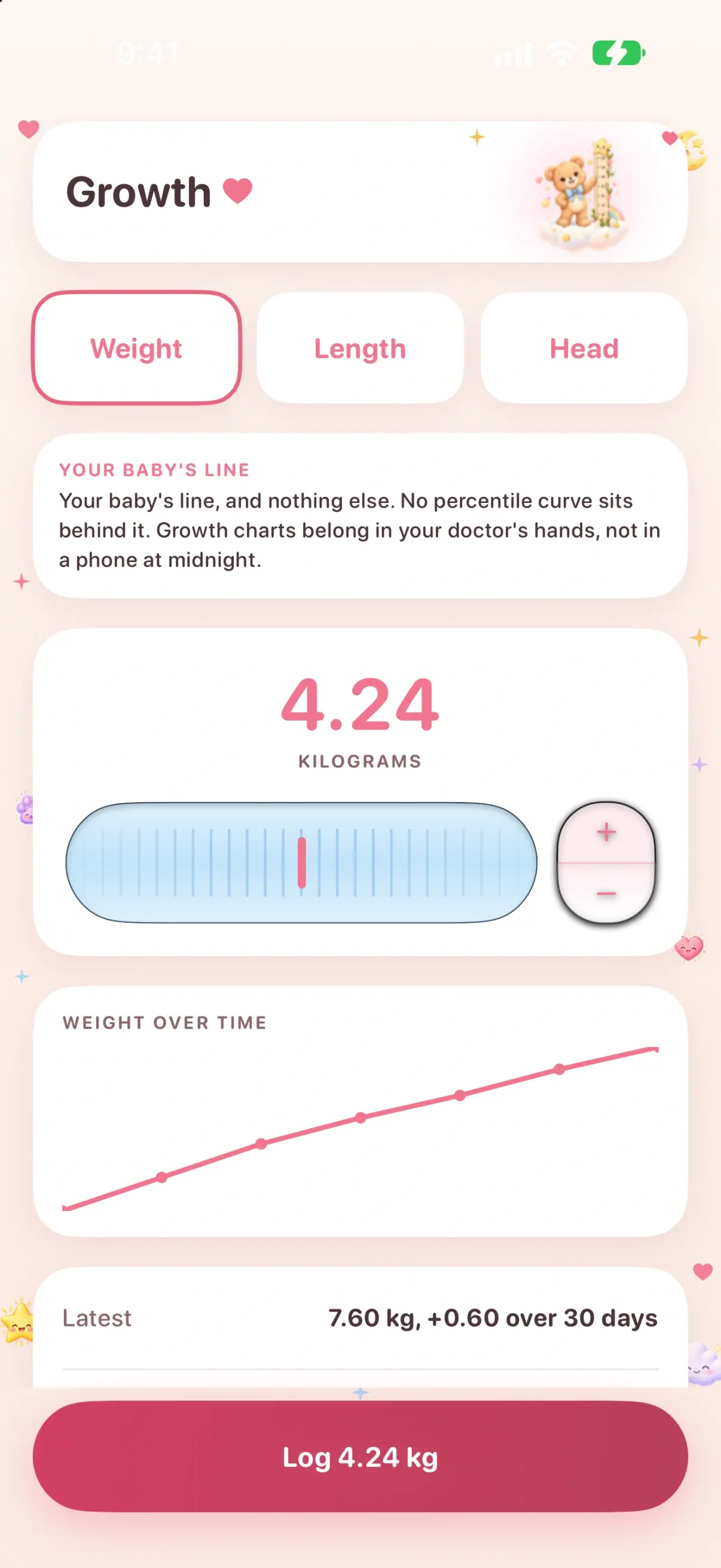
| Weight | You want checkup weights in one place | What did the scale say last time? |
| Sleep | You are working on sleep with your pediatrician | How did naps and nights go this week? |
- Ask at the next visit whether your pediatrician needs anything tracked, and for how long.
- Choose the one log you would miss. If nobody is asking for diaper counts, those usually go first.
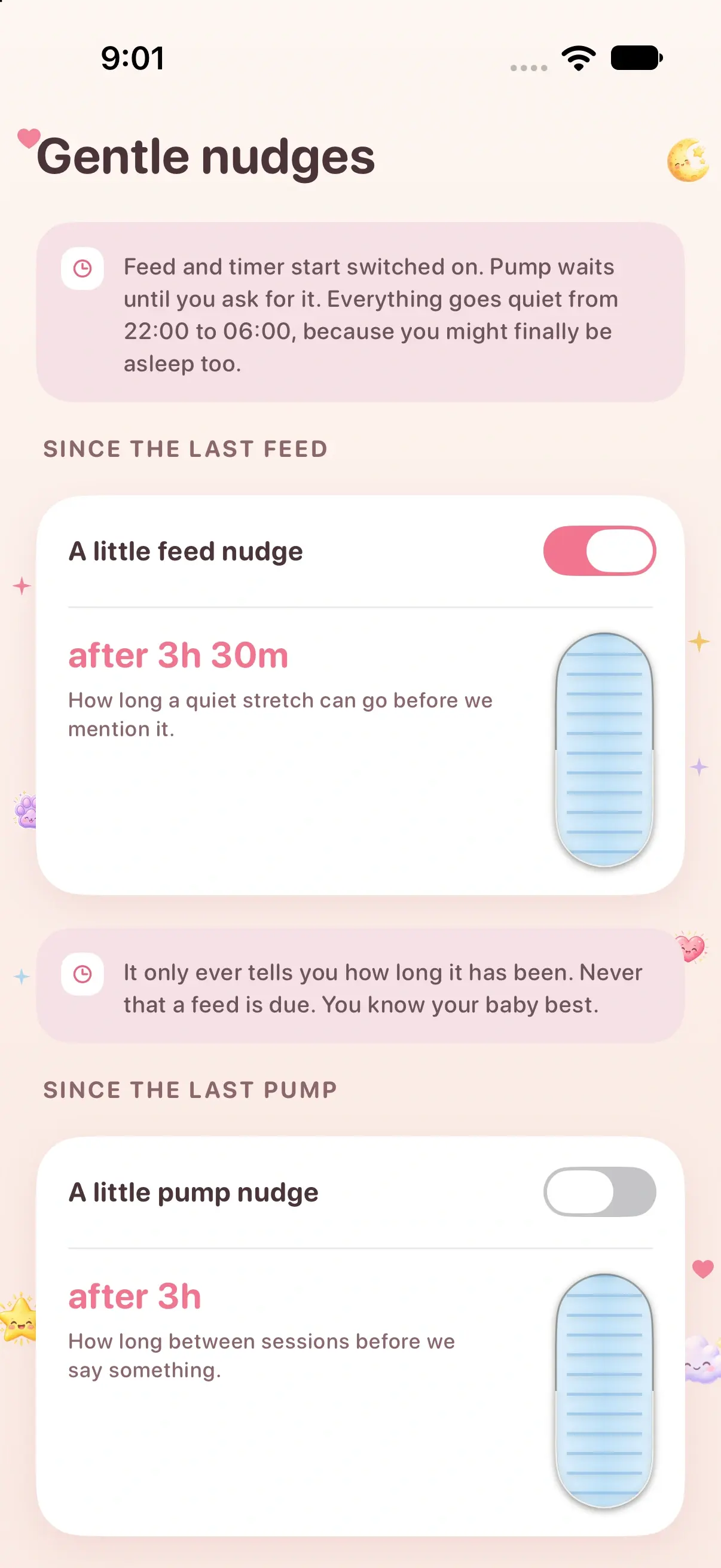
- Run a week with only that log. Turn off any reminders you no longer need, so the phone stops nudging you about the rest.
- Tell every caregiver what is still being logged. Otherwise a missing entry reads as “it did not happen.”
- If a concern comes back, start again. A day or two of fresh entries is enough to answer most questions.
Breastfeeding, bottles and sleep end at different times
Breastfeeding. You cannot see the volume, so early on the log and the weight checks stand in for it. Once your pediatrician is satisfied, many parents keep just the start time and side, because “which side was last?” is the question that survives.
Bottles and formula. The amount is visible in the bottle, so a log mostly helps when someone else does the feeding or when your pediatrician asks for daily totals. Ask whether they still want them.
Pumping. If you are pumping, a pumping log may matter to you or a lactation consultant for longer than the feeding log. That timeline is between you and them.
Sleep. A sleep log answers pattern questions: how naps are going, whether a change is working, what happened overnight. It tends to be the last log parents give up, and it is reasonable to keep it while you are actively working on sleep and stop when you are not.
Reasons to keep logging longer
Some situations make a log worth keeping well past the first weeks. In each, the person who asked for the information decides what to record, and you can stop once they say so.
Scroll sideways to compare every column.
When a longer log helps. Your pediatrician or care team decides the details.
| Situation | What to keep | Who decides when to stop |
|---|---|---|
| A weight concern | Whatever your pediatrician asks for | Your pediatrician |
| A medical condition, prematurity or a NICU stay | What the care team asks you to record | The care team |
| Any medicine | Each dose, the time and who gave it | When the course ends |
| A new caregiver (daycare, grandparent, nanny) | Feeds, naps and diapers for the handover | You, once the routine settles |
| Sleep work | Sleeps and night wakings | You, once the plan is done |
| An illness | Feeds, wet diapers and temperatures | Your pediatrician |
Medicine is the clearest case. The AAP’s guide to over-the-counter medicines for children says, “Use a log to keep track of what times you gave medicine to your child,” and asks you to work with other caregivers on how you will track what was given, how much, and when. If two adults share the care, a shared log is how you avoid a double dose. Our guide to sharing a baby log with your partner on iPhone covers setting that up.
Keeping the record for later
Stopping the daily log is different from throwing the record away. The first weeks can be useful later: for a new pediatrician, a specialist referral, a baby book, or comparing notes when a sibling arrives. Keep what you have, even if you never add to it again.
In Zen Otto, records are stored on your iPhone, and when iCloud sync is on, also in your private iCloud database. Ending a subscription does not delete your logged records, and you can export a record when you need a separate copy. Before deleting any data, the Zen Otto privacy policy recommends keeping an export of anything you want to retain.
Do you need an app for what is left?
If you are about to stop tracking entirely, you do not need to buy anything. Paper or a note on your phone is enough for one category. Zen Otto suits families who want to keep a few logs with one hand, share them with another caregiver, and keep the history in one place. Our guide to keeping a baby feeding, diaper and sleep log on iPhone shows the setup.
Zen Otto is paid: a monthly or yearly subscription, or a one-time purchase. Eligible subscriptions include a three-day free trial, and Apple confirms eligibility and local pricing before purchase. It records care information; it is not a medical device and does not give medical advice. See the screens on the Zen Otto product page.